
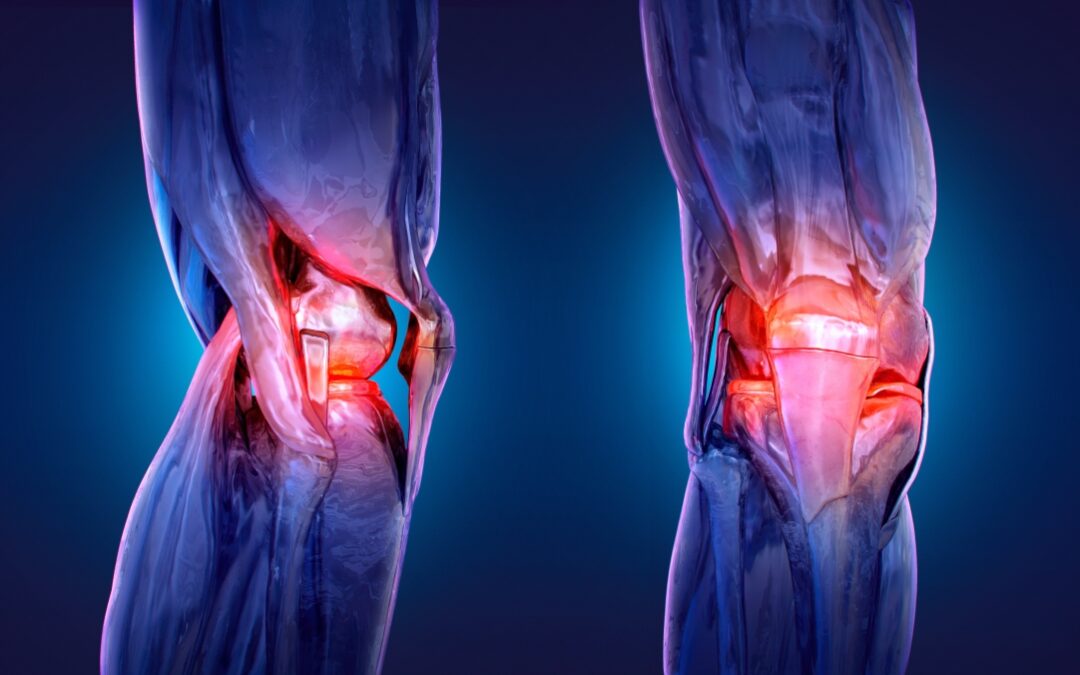
What Is a “Stiff Knee”?
After knee replacement surgery (also called total knee arthroplasty), stiffness refers to a persistent limitation in the knee’s range of motion compared to what is expected at that stage of recovery.
This may include:
- Difficulty fully straightening the knee
- Difficulty bending the knee
- Or a combination of both
For everyday function:
- About 65° of bend is needed to walk comfortably
- Around 90° is needed to sit and stand easily
- 100–110° allows for stairs and most daily activities
If knee movement remains significantly limited — particularly less than 90° of bend by three months after surgery — further assessment is recommended.
Why Does Knee Stiffness Occur?
Knee stiffness after replacement surgery is usually multifactorial, meaning more than one factor may contribute.
Common causes include:
- Scar tissue formation (arthrofibrosis) inside the joint
- Limited movement before surgery, which increases the risk of stiffness afterward
- Pain and swelling, which inhibit normal movement and muscle activation
- Delayed or inconsistent rehabilitation
- Inflammation or infection (uncommon, but important to exclude)
- Mechanical factors, such as implant positioning (rare, but relevant in certain cases)
In some patients, the nervous system plays a role by temporarily reducing quadriceps muscle activation after surgery. This protective response can become persistent if not addressed early and may contribute to stiffness.
Why Early Action Matters
One of the most important principles in managing a stiff knee is early intervention.
The first 6–12 weeks after surgery represent a critical window during which:
- Scar tissue is still adaptable
- Muscles can be retrained effectively
- Range of motion responds best to rehabilitation
Waiting too long can make stiffness harder to reverse.
Key Management Strategies
- Structured Physiotherapy
Physiotherapy is the cornerstone of treatment for knee stiffness.
Rehabilitation focuses on:
- Restoring full knee straightening (extension)
- Gradually improving knee bending (flexion)
- Daily exercises such as heel slides, cycling motions, and gentle strengthening
Consistency matters more than intensity. Small, regular gains add up over time.
- Early and Safe Mobilisation
Movement is encouraged as early as possible after surgery, usually within the first day.
Walking and controlled knee movement help:
- Prevent excessive scar tissue formation
- Improve circulation
- Restore muscle coordination
- Pain and Swelling Control
Pain and swelling are major contributors to stiffness.
Effective management may include:
- Ice packs (typically 20 minutes at a time)
- Elevation of the leg
- Appropriate medication as prescribed
Good pain control enables better movement and more effective rehabilitation.
- Mechanical Support (When Appropriate)
In selected cases, additional tools may support recovery:
- Devices that gently maintain or guide knee movement
- Temporary splints or braces used during rest
These measures are supportive and are always used alongside active rehabilitation, not instead of it.
- Manipulation Under Anaesthesia (MUA)
If progress plateaus and knee movement remains restricted despite rehabilitation, manipulation under anaesthesia may be considered.
This involves gently moving the knee while the patient is under anaesthetic to release scar tissue.
Evidence shows that MUA is most effective when performed within the first three months after surgery, although it may still be helpful later in selected cases.
- Arthroscopic Treatment (Selected Cases)
If stiffness persists, a minimally invasive arthroscopic procedure may be used to remove scar tissue directly from within the joint.
This option is typically reserved for patients who do not respond adequately to non-surgical measures.
- Revision Surgery (Uncommon)
Revision knee surgery is considered only in resistant cases, usually where stiffness is caused by mechanical factors that cannot be corrected otherwise.
This is uncommon and follows careful investigation.
The Importance of Patient Participation
One of the strongest predictors of recovery is patient engagement.
- Exercises should be performed regularly at home
- Early discomfort is normal and does not mean harm
- Open communication with the care team is essential
Each degree of movement gained early helps protect long-term function.
A Note on Access and Individual Circumstances
While some treatment options may vary depending on individual circumstances, the principles of managing knee stiffness are the same for everyone.
Early movement, good pain control, and consistent rehabilitation form the foundation of recovery in all settings. Many patients recover excellent function through structured exercises and physiotherapy alone, without requiring additional procedures.
Treatment is always adapted to what is appropriate, available, and safe for each individual patient.
Can Knee Stiffness Be Prevented?
Not entirely — but the risk can be reduced by:
- Addressing limited movement before surgery where possible
- Starting rehabilitation early
- Ensuring effective pain control
- Avoiding prolonged immobilisation
- Identifying muscle inhibition early and treating it appropriately
A stiff knee after knee replacement is not a failure and does not mean the operation has gone wrong.
With early recognition, appropriate rehabilitation, and timely intervention when needed, most patients regain functional movement and return to daily activities comfortably.
If progress feels slower than expected, early assessment allows for simple solutions before stiffness becomes entrenched.
This article “Managing a Stiff Knee After Knee Replacement” does not provide medical advice and is intended for informational purposes only. It is not a substitute for professional medical advice, diagnosis or treatment. Please consult a doctor for all medical advice.
sources:
https://www.royaldevon.nhs.uk/
https://www.professeur-cavaignac.com/
https://pmc.ncbi.nlm.nih.gov/
https://universityorthopedics.com/
https://orthoinfo.aaos.org/

Meet Dr Peter Smith, a leading Orthopaedic Surgeon operating from the Mediclinic Milnerton in Cape Town, Western Cape. His practice is situated in the heart of this seaside town. Dr Peter Smith not only offers patients the full spectrum of professional orthopaedic treatments, but specialises in total knee replacement, total hip replacement, sports injuries and the latest arthroscopic surgery techniques and computer guided surgery. He gained extensive experience in the latest arthroplasty techniques during his stay of 6 years in Australia where he performed more than a hundred primary and revision hip and knee replacements cases in a year.